
The shrub that rewrote the family tree
A small, inconspicuous plant growing only in the mountain forests of Grande Terre holds a position in botanical history that nothing else on earth can claim.
A lineage apart
Amborella trichopoda is not impressive to look at. It grows as a straggling shrub or small tree, rarely more than eight metres tall, in the shaded understorey of humid highland forest — on slopes above the Rivière Bleue Provincial Park, on ridges around the Aoupinié massif, scattered through the wetter montane zones of Grande Terre.
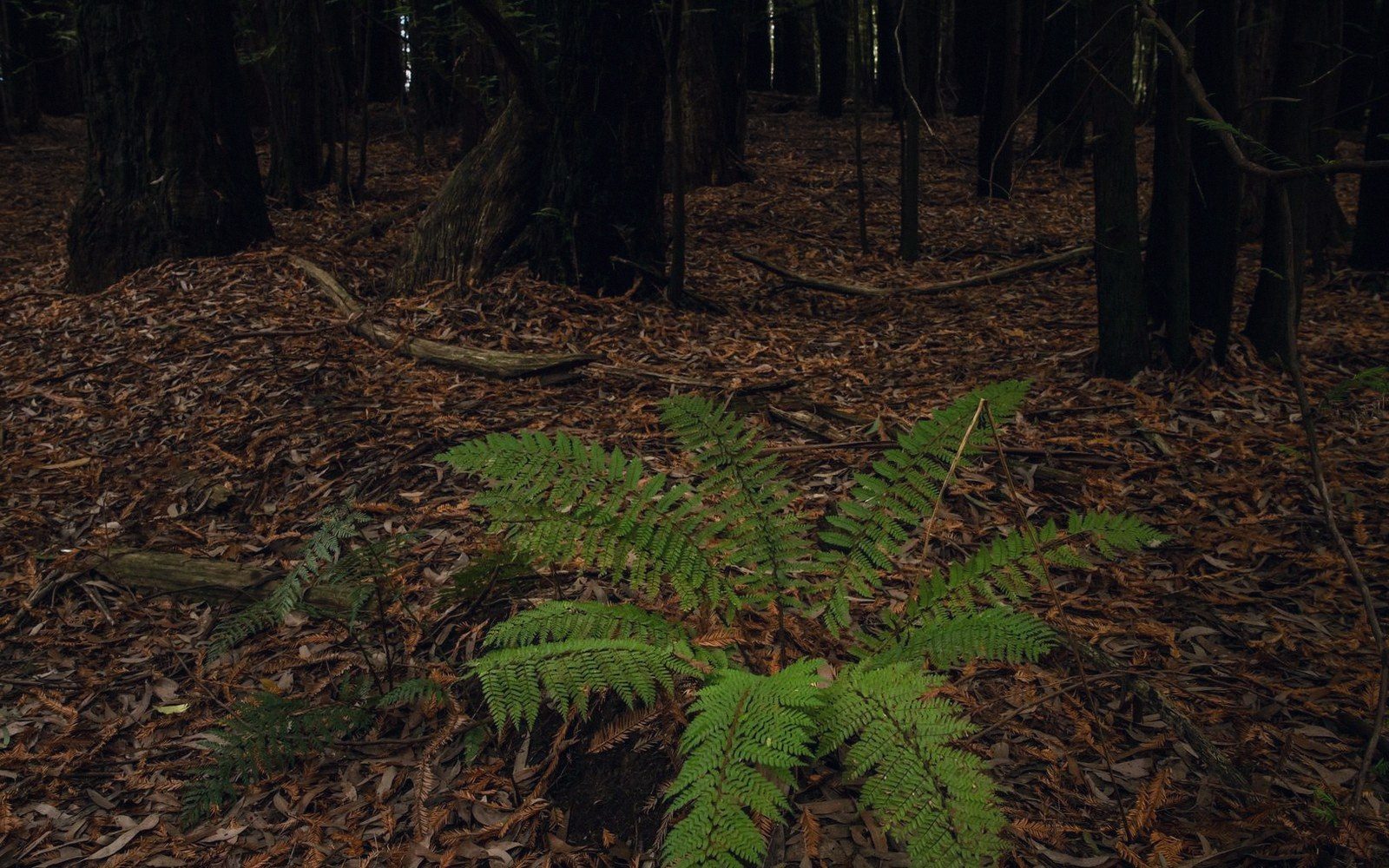
The leaves are thin, alternate, slightly toothed; the flowers tiny, cream-yellow, and unremarkable to any eye not trained on botanical structure. A hiker passing it would notice nothing. A botanist recognises it as the single most important flowering plant alive.
Amborella is the sole member of its family, Amborellaceae, and the sole member of its order, Amborellales. Its closest relatives are not other shrubs of New Caledonia; they are all other flowering plants on earth.
When molecular phylogenetics began resolving the deep structure of angiosperm evolution in the late 1990s and early 2000s — work drawing on DNA sequences and computational methods that earlier morphological study simply could not achieve — Amborella emerged with remarkable consistency as the sister lineage to every other flowering plant.
Not the ancestor: that distinction matters. Amborella has been evolving in its own direction for as long as all other angiosperms have been evolving in theirs. But the split between the Amborella lineage and the rest happened first. It is the earliest-diverging branch on the angiosperm family tree, which makes the tree of every rose, every oak, every orchid, every cereal grass, a tree that forks on one side into Amborella and on the other into everything else.
The implication is that Amborella retains — in some features, not all — characteristics that may reflect those of the common ancestor of all flowering plants. Its flowers are structurally simple: no clear distinction between petals and sepals, instead a graduated series of tepals; no vessels in the wood, only tracheids, a plumbing arrangement typical of conifers and ferns rather than most angiosperms.
These are not necessarily primitive features so much as unmodified ones, but they give biologists a reference point. Understanding what the earliest flowers were like — a question Charles Darwin famously called an "abominable mystery" — requires some anchor in the living world. Amborella is that anchor.
Only here
The plant grows exclusively in New Caledonia, and within New Caledonia, only in the montane forest of Grande Terre. It is not found on the Loyalty Islands — Ouvéa, Lifou, Maré — nor on Île des Pins, nor anywhere else on earth.
This extreme endemism is consistent with the deep-time isolation of Grande Terre after its separation from Gondwana: an island that drifted away from the supercontinent carrying lineages that then evolved in isolation, sheltered by geography from both competition and extinction events that reshaped floras elsewhere.
The New Caledonian archipelago as a whole has extraordinarily high endemism — roughly three-quarters of its native vascular plants occur nowhere else — but Amborella represents an entirely different order of uniqueness. Every other endemic is one species within a family shared with the wider world. Amborella is the entire family, the entire order, and the earliest branch of a lineage that contains a quarter of a million species.
The habitat it favours is specific: shaded, humid, montane forest on non-ultramafic substrate — not the metalliferous soils that dominate the southern massifs and carry the extraordinary maquis minier scrub. Amborella appears to need stable, relatively undisturbed canopy.
It is listed as vulnerable by the IUCN, threatened by invasive species — particularly the red deer introduced in the nineteenth century, which browse its regeneration — and by any disturbance that opens the canopy. Forest clearance for nickel extraction, logging, and fire are the principal pressures. The plant does not regenerate easily in degraded conditions.
Field notes
Facts, threats and strongholdsWhat makes Amborella scientifically extraordinary
- Wood lacks vessels; has tracheids instead, like conifers — an unmodified ancestral feature
- Flowers are structurally simple tepals, not differentiated petals and sepals
- Functionally dioecious but can switch between male and female phases over time
- Genome sequenced and published in Science, 2013, confirming phylogenetic position
Scale of rarity
- One species, one family, one order — entirely confined to montane forest on Grande Terre
- Does not grow on any other island in the New Caledonian archipelago
- Listed as vulnerable by the IUCN; threatened by deer browse, canopy clearance, invasive species
Sex, structure, and what the flowers tell us
Amborella is unusual even in its reproductive biology. Individual plants are functionally either male or female in any given flowering season — a condition called functional dioecy — but they can switch between phases over time. The flowers lack the nectaries common in more derived angiosperms; they appear to be pollinated primarily by insects visiting for pollen rather than nectar, which suggests something about the pollination ecology of early angiosperms before the diversification of nectar-producing flowers and their specialist pollinators.
The Amborella Genome Project, published in Science in 2013, sequenced the full genome and confirmed the phylogenetic position through an independent line of evidence. The genome analysis also revealed ancient whole-genome duplications in the angiosperm lineage that did not affect Amborella, reinforcing the picture of a lineage that diverged early and independently.
The Muséum national d'Histoire naturelle in Paris and the Institut de Recherche pour le Développement — known as the IRD, whose research station in Nouméa has long worked on New Caledonian flora — have both contributed to the botanical documentation of the plant and its habitat.
Living specimens of Amborella are maintained in several botanical gardens outside New Caledonia for research purposes, including collections at institutions in Europe and North America. But there is no substitute population in any ecological sense; the plant exists as a functional wild organism only in the mountain forests of Grande Terre.
What it means
The significance of Amborella for evolutionary biology is difficult to overstate. Flowering plants account for the overwhelming majority of terrestrial plant species and underpin most terrestrial ecosystems, including every major agricultural system humans have developed. The question of how they originated, and when, and what they looked like at their emergence in the Cretaceous, is one of the central problems in plant evolutionary biology.
Darwin identified the rapid appearance of angiosperms in the fossil record as deeply puzzling. A living lineage that branched at the very base of the tree does not answer that question directly — Amborella has had as much evolutionary time as anyone else — but it constrains the answer. Its wood anatomy, its floral structure, its genome, its reproductive biology: all are data about what was present at the base of the tree, and what changes came later.
For New Caledonia, Amborella sits alongside the kagu, Corvus moneduloides, and the hyperaccumulating plants of the ultramafic massifs as evidence that this island's biological distinctiveness is not simply regional — it is global. The highland forest on a ridge above the Rivière Bleue, where a botanist might crouch beside an unremarkable shrub with tiny cream flowers, is the kind of place where the planet's biological history is still written in living organisms. There are very few such places left.