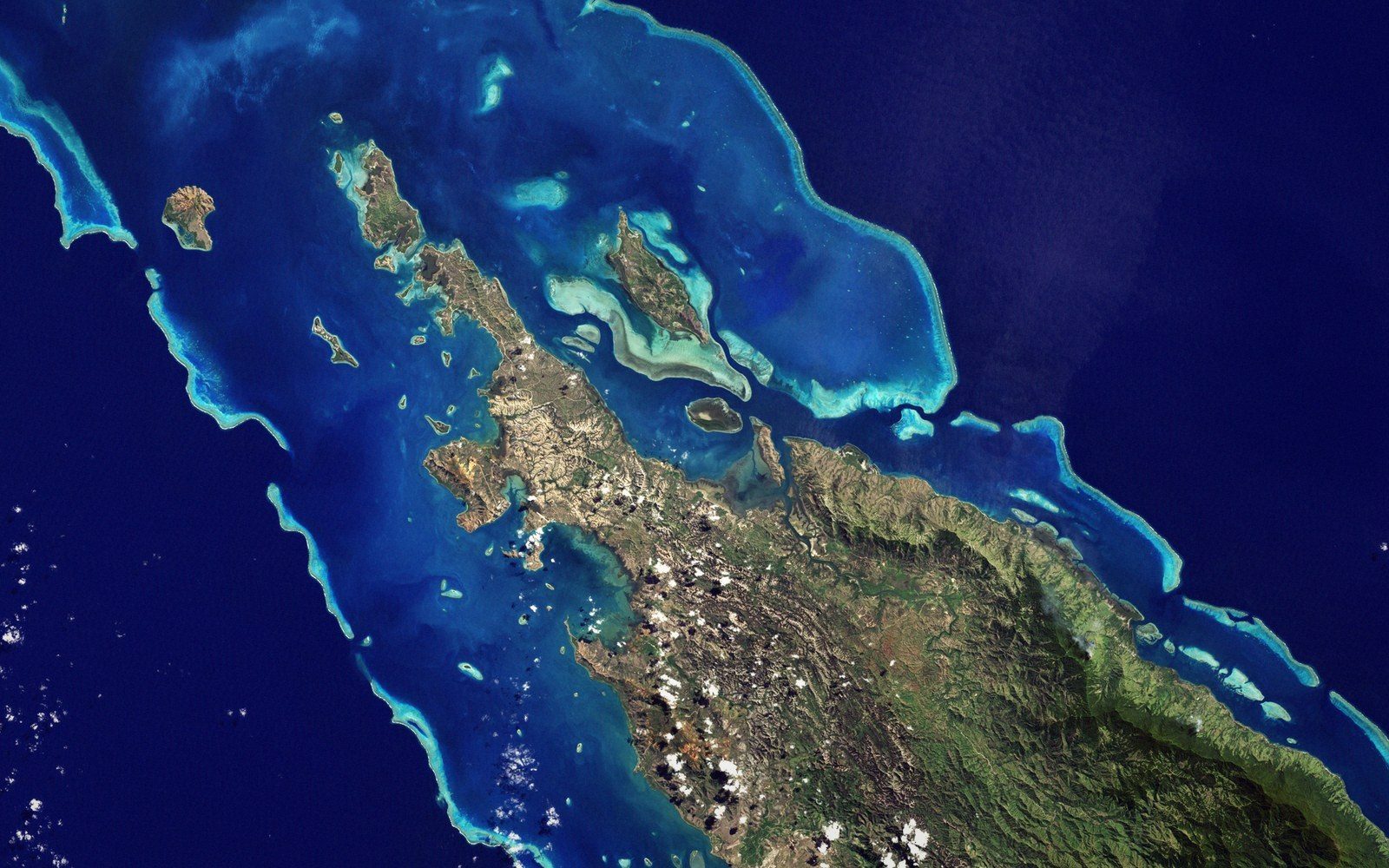
The break
Around eighty million years ago, the landmass that would become Grande Terre tore away from the eastern margin of Gondwana. The mechanism was the same rifting that separated New Zealand, New Caledonia and other fragments of what geologists call Zealandia from the Australian and Antarctic portions of the supercontinent — a slow extensional pulling-apart along fault lines, rather than a single catastrophic event.
The Tasman Sea opened as a consequence. By roughly fifty-five million years ago, the drift had essentially stopped, and Grande Terre was marooned in the southwest Pacific with whatever Gondwanan life it had carried aboard.

That timing matters enormously. The island was isolated before the explosive diversification of flowering plants had run its course, before placental mammals had colonized most of the world, and before many of the bird and reptile lineages familiar elsewhere had spread to this corner of the globe.
The isolation was not merely geographic; it was evolutionary. Life on Grande Terre took its own path for tens of millions of years, and what that path produced is unlike anything in Australia, mainland Asia, or the Pacific island chains that rose later from purely oceanic crust.
The figures
Lifted out of the textThe obduction event
The story has a second act. Around thirty-four million years ago, an extraordinary event reshaped the island's geology: a slab of oceanic crust, composed largely of peridotite — an ultramafic, silica-poor rock from deep in the mantle — was thrust up and over the southern part of Grande Terre in a process called obduction.
The result is the ultramafic massifs that cover roughly a third of the island's southern extent, an exposure of mantle-derived rock at the surface on a scale almost unmatched anywhere on land.
Peridotite weathers slowly but with chemical consequences that are severe. The process strips out silica and concentrates metals — nickel, cobalt, chromium, manganese — in the residual laterite soils. Those soils support a flora that has adapted, over geological time, to conditions that are toxic by the standards of ordinary plant chemistry.
The result is the maquis minier, a low, metallophyte scrub found nowhere else on earth, and plants such as Pycnandra acuminata, whose latex runs blue-green with dissolved nickel. Geological event and biological peculiarity are inseparable here: the obduction explains the soils, the soils explain the plants.
What isolation preserved
Rifting separated Grande Terre before the native fauna of most of the world had assumed its modern shape. There were no terrestrial mammals on the raft — none arrived overwater afterward either, except bats — so the ecological niches that mammals fill elsewhere were left open. Birds and reptiles inherited them.
The kagu, Rhynochetos jubatus, a flightless, grey forest-floor bird with no close living relatives, is one consequence. The large geckos of the genus Rhacodactylus, the tool-making crow Corvus moneduloides, the extraordinary lizard fauna — all reflect a world shaped by the absence of ground predators and competitors that everywhere else co-evolved with mammals.
The botanical archive is equally stark. Amborella trichopoda, a modest shrub confined to Grande Terre's mountain forests, belongs to the earliest-diverging lineage of all living flowering plants. It did not get to this island; the island was under it when flowering plants first diversified. That fact alone makes Grande Terre a reference point for understanding plant evolution globally, and the Muséum national d'Histoire naturelle and IRD have both sustained long-term research programs here as a consequence.
Field notes
Facts, threats and strongholdsWhat the isolation produced
- Amborella trichopoda — sole living member of the sister lineage to all other flowering plants
- Rhynochetos jubatus (kagu) — flightless, no close relatives
- Pycnandra acuminata — latex colored blue-green by dissolved nickel
- Maquis minier — metallophyte scrub unique to ultramafic soils
Eighty million years of isolation is not an abstraction. It is the shape of the lagoon, the chemistry of the soil, the silence of a forest without monkeys or cats, and the color of a plant's sap. Everything peculiar about this island begins with the same event: a crack in a supercontinent, and a small piece of old ground drifting east into the Pacific.