
What the ground is made of
Peridotite is not crust. It is the stuff that normally stays buried beneath it, dense olivine-and-pyroxene rock from the earth's upper mantle. In New Caledonia, a collision event roughly thirty-four million years ago drove an enormous slab of oceanic crust and the peridotite beneath it up and over the edge of Grande Terre — an obduction event that geologists call the rift and drift story's violent epilogue.
The result is one of the largest ultramafic massifs on earth, covering the island's southern third and surfacing again in scattered outcrops further north. The plateau above Nouméa, the massifs around the Baie de Prony, the range that frames the Rivière Bleue Provincial Park — all of it is this same ancient mantle rock, now exposed to weather and root.
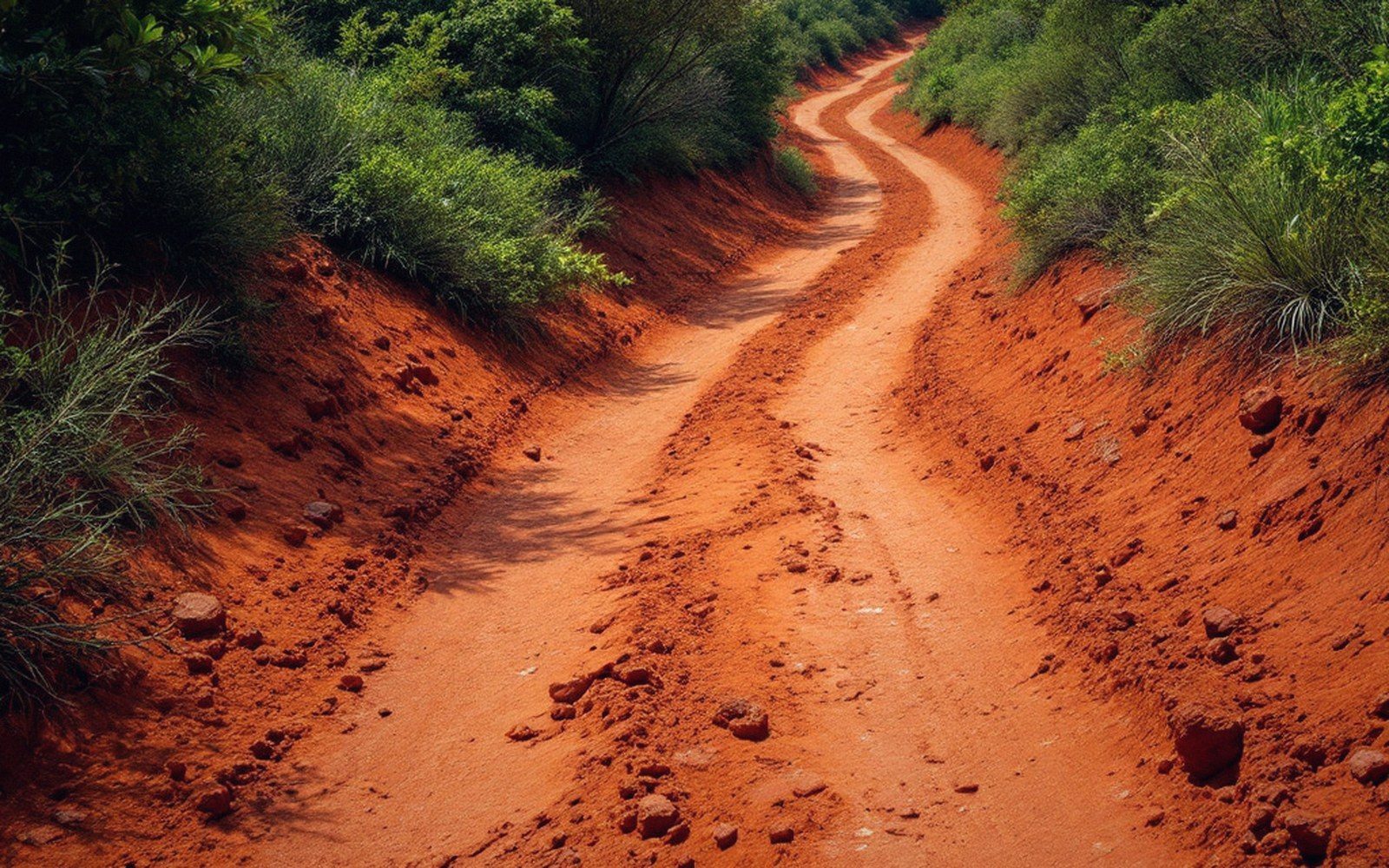
When peridotite weathers under a tropical climate it does not produce normal soil. It produces laterite: a thin, iron- and magnesium-rich crust that sheds calcium, potassium and phosphorus — the elements plants most depend on — almost entirely.
What remains behind is a cocktail of heavy metals, principally nickel, chromium and cobalt, toxic at the concentrations found here to most of the world's plant life. The iron oxides colour the landscape in tawny reds and ochres. Where Jules Garnier identified a green magnesium-nickel silicate in the 1860s and named it garnierite, he was reading what centuries of this weathering had concentrated into ore.
What grows anyway
The plants that colonise this ground have had millions of years to adapt, and some of the results are extraordinary. The maquis minier — the low, dense scrub that covers the massifs — holds roughly two thousand species, most of them found nowhere else on earth, and the proportion of endemics among them is among the highest recorded for any vegetation type globally. Many are simply tolerant of metal loads that would kill a temperate garden plant outright.
A smaller number go further: they are hyperaccumulators, drawing nickel or manganese actively into their tissues in concentrations that would be lethal by normal biochemistry. Pycnandra acuminata, a tree in the family Sapotaceae, carries so much nickel in its latex that the sap runs blue-green — a visible marker of an adaptation that may deter herbivores or regulate the metal's toxicity to the plant itself.
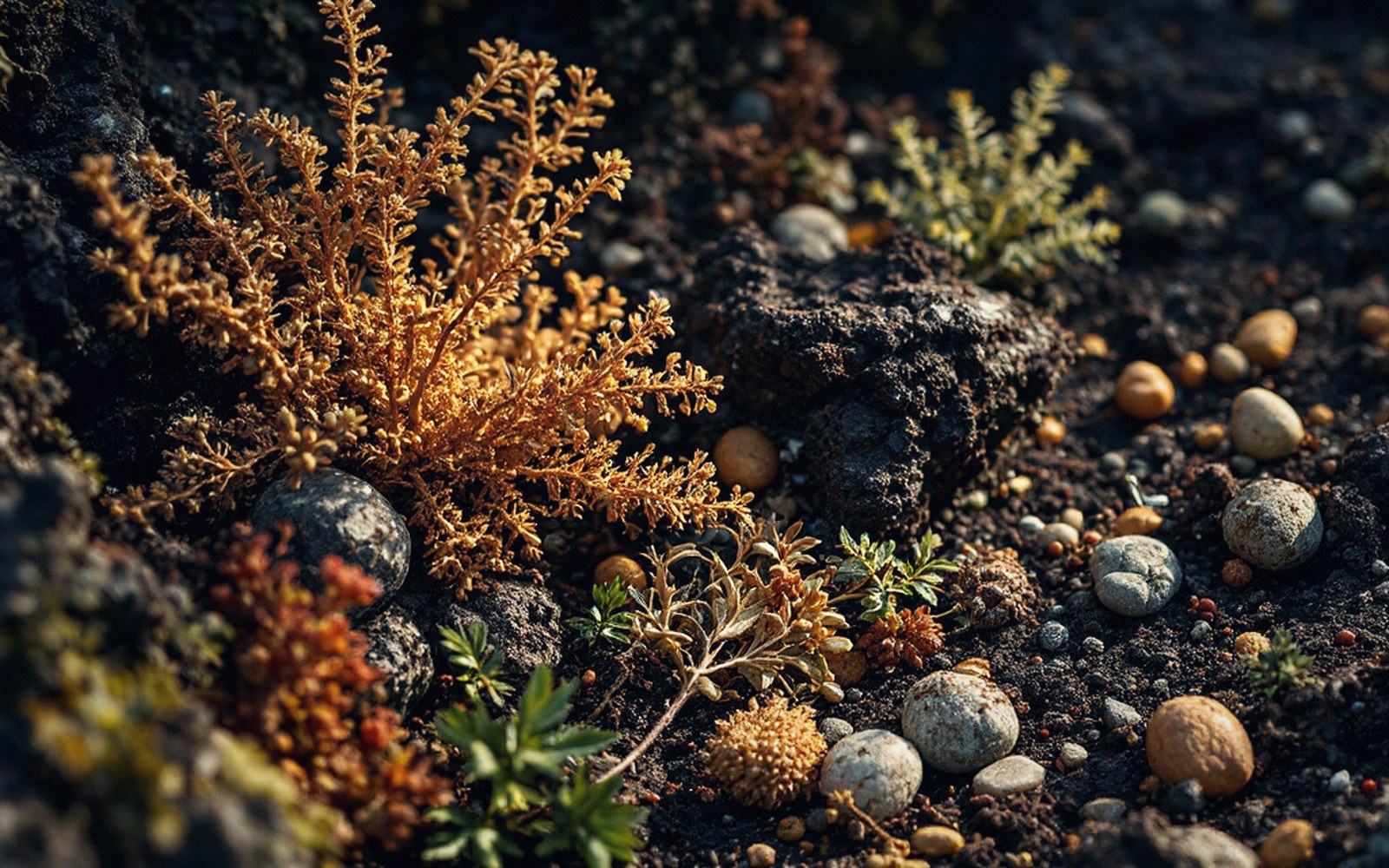
The nutrient poverty matters as much as the metal toxicity. Low phosphorus selects for plants with very efficient root systems or mycorrhizal partnerships. Low calcium alters cell-wall chemistry. The result is not just a tolerant flora but an architecturally distinct one: small, hard leaves, slow growth, a tendency toward unusual flower structures, and an extraordinary degree of species packing in a thin soil that looks, to an outsider, almost incapable of supporting anything.
The figures
Lifted out of the textAmborella trichopoda, the single living species at the base of the entire flowering-plant lineage, grows in the wetter forest above the massifs, not on the ultramafic ground itself, but the island's overall flora has been shaped by the same combination of isolation and edaphic extremity.
Field notes
Facts, threats and strongholdsKey geochemical terms
- laterite — iron-rich weathering product of peridotite; thin, metal-laden, nutrient-poor
- hyperaccumulator — plant that concentrates heavy metals in its tissues far beyond background levels
Key figures
- Ultramafic massifs cover roughly one-third of Grande Terre's land area
- Among the highest endemic-species proportions recorded for any vegetation type globally
- Nickel, chromium and cobalt are the principal heavy metals concentrated in laterite soils here
Scale and significance
The ultramafic zone of Grande Terre accounts for a disproportionate share of global nickel reserves; the mines at Thio are among the longest-operating in the world. That fact and the botanical one are in direct tension: the same geochemistry that makes the maquis minier irreplaceable makes the ground beneath it commercially valuable.
Mine rehabilitation on laterite is technically possible but slow — the soils that produced this endemic flora took geological time to form, and a disturbed surface cannot be returned to its prior state within any human timescale. The Rivière Bleue Provincial Park protects portions of it. What those boundaries enclose, and what lies outside them, is the practical arithmetic of a landscape simultaneously unique and extractable.