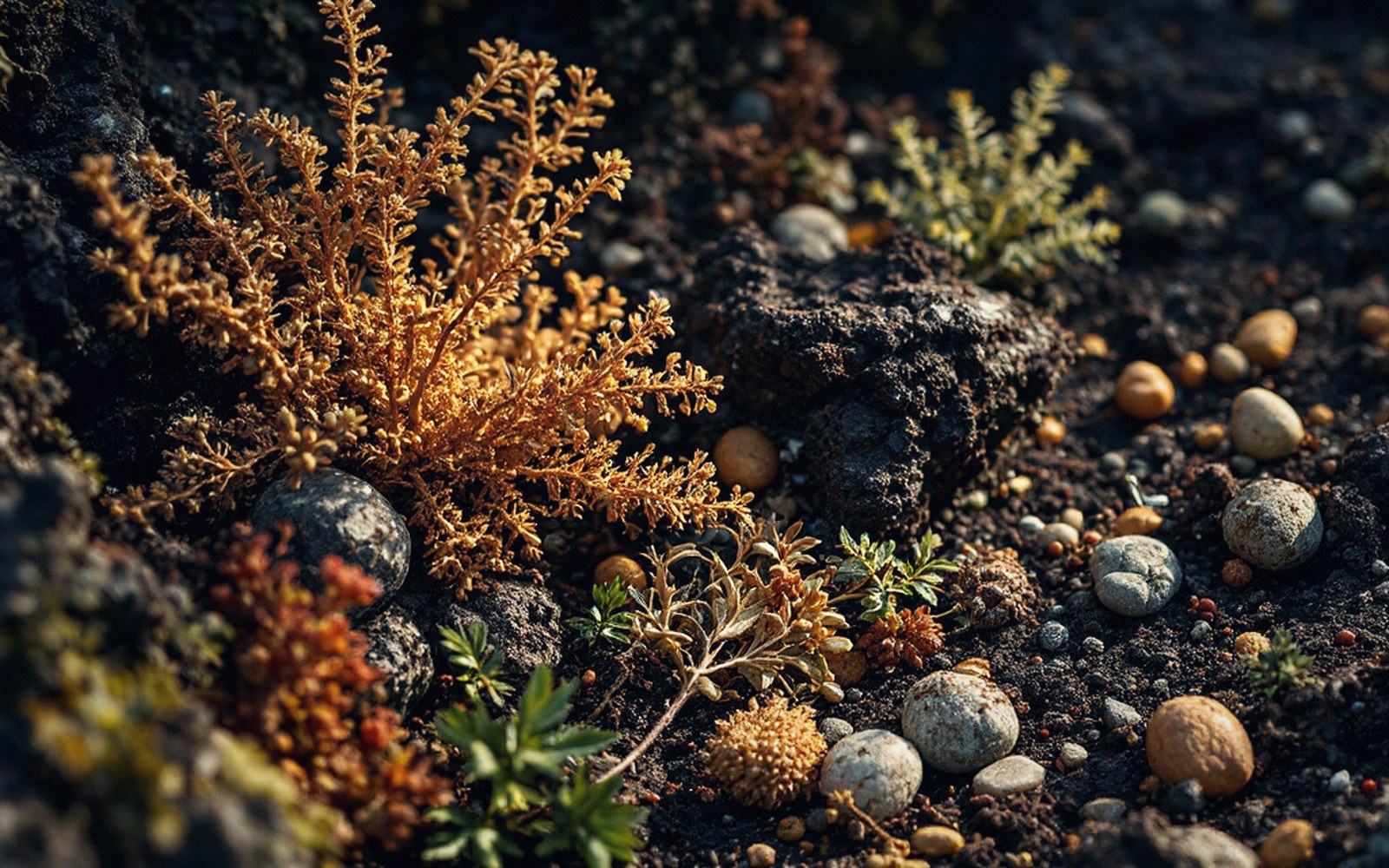
A scrub built on poison
The plant community known as maquis minier — mining scrub — grows on some of the most hostile ground on earth. The substrate is ultramafic peridotite, pushed up across Grande Terre's southern third and scattered in massifs further north.
When peridotite weathers, it produces a laterite soil that is simultaneously rich in heavy metals — nickel, chromium, cobalt, manganese — and poor in the calcium, nitrogen and phosphorus that most plants need. The result is a slow, low, wind-battered scrub of extraordinary botanical originality.
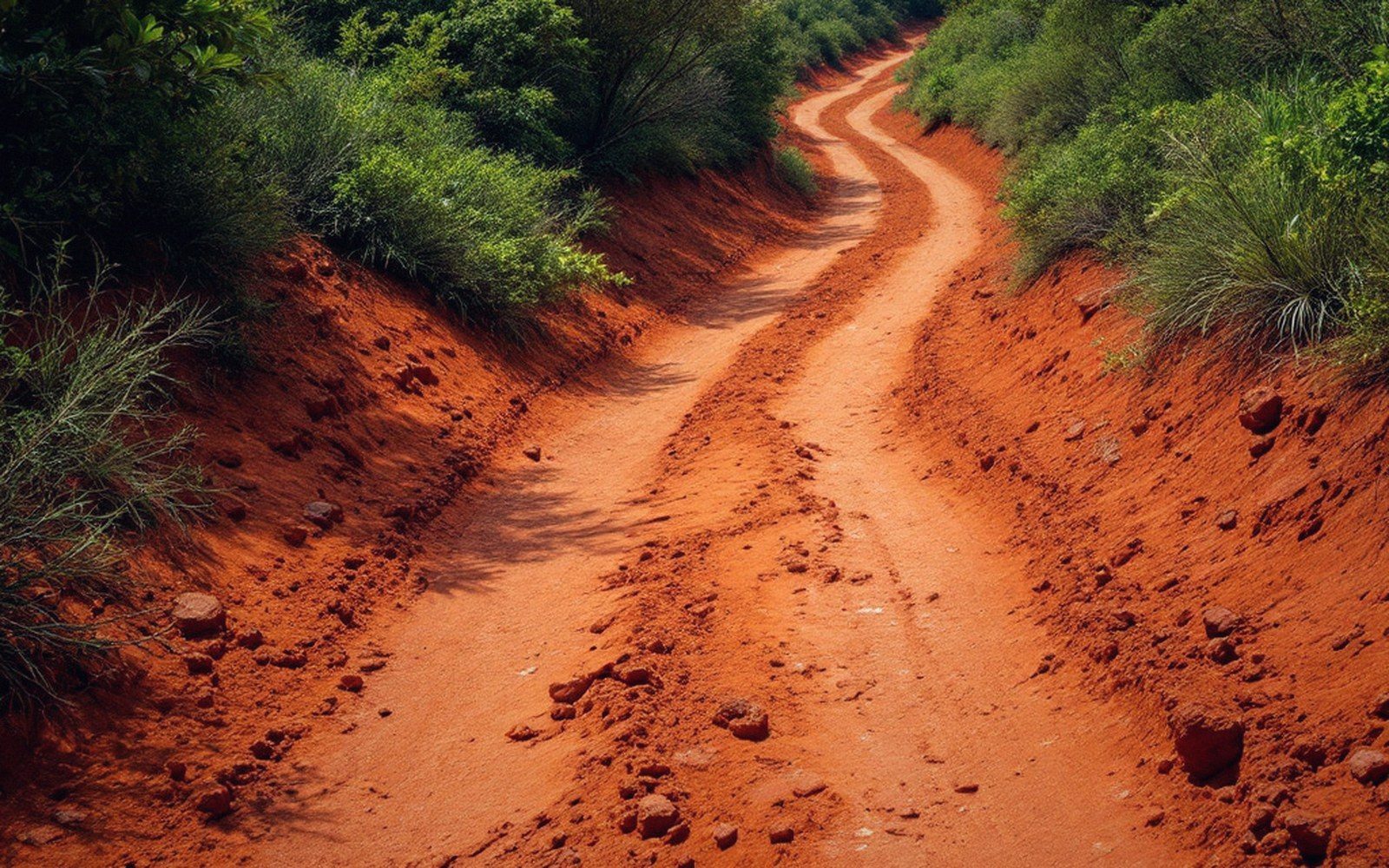
Walking onto the maquis from surrounding rainforest, the shift is immediate. The canopy drops from thirty metres to chest height or below. The soils are orange-red where fresh laterite breaks the surface. What grows there is sparse, often gnarled, and disproportionately strange: a high fraction of the species have no close relatives anywhere else and, strikingly, no populations anywhere else on the island, let alone beyond it.
Why species stay put
The maquis minier is not a single community. It is a mosaic of communities, each calibrated to the local chemistry of a specific massif — its particular nickel-to-magnesium ratio, its depth of laterite, its exposure.
A species adapted to the soils of one massif may find the chemistry of a neighbouring massif subtly hostile, even though both are ultramafic. The practical consequence is an extreme kind of endemism: species endemic not just to New Caledonia but to one ridge, one plateau, one drainage.
Botanists from the IRD (Institut de Recherche pour le Développement) and the Muséum national d'Histoire naturelle have catalogued this pattern across decades. The flora of the southern massifs around the Baie de Prony and the nickel-mining area at Thio differs measurably from what grows on the ultramafic massifs of the far north, such as Tiébaghi. Rivière Bleue Provincial Park protects a representative section, but the maquis is distributed unevenly, and a meaningful share of its species grow in places with no formal protection.

The plants that thrive here have evolved several solutions to the metal problem. Some exclude metals almost entirely at the root level. Others simply tolerate elevated tissue concentrations. A remarkable subset go further: hyperaccumulators actively draw metals into their leaves, apparently as a defence against herbivores and microbial attack.
Pycnandra acuminata, a tree of the wet ultramafic forest edge, concentrates so much nickel in its latex that the sap runs blue-green. New Caledonia has more documented hyperaccumulator species than any comparable area on earth.
Field notes
Facts, threats and strongholdsKey terms
- laterite — reddish iron- and metal-rich soil that forms as peridotite weathers
- hyperaccumulator — a plant that draws heavy metals into its tissues, often at concentrations lethal to other species
- endemism — the condition of being native to, and found only in, one defined place
Scale and pattern
- Grande Terre's southern third is the main ultramafic zone, with further massifs in the north
- Species endemism can be massif-specific, not just island-specific
- New Caledonia holds more documented hyperaccumulator species than any comparable area globally
What the scrub actually looks like
The maquis minier is not monotonous, though it can look it from a distance. Restiaceae — rush-like plants with jointed stems, a family with Gondwanan roots — share ground with dwarf Araucaria, several species confined entirely to this substrate, and with shrubs in the Proteaceae family that have adapted their roots to extract phosphorus where almost none exists. Orchids push through the laterite crust. A single boulder can carry three species found nowhere else on the planet.
The vegetation is also tied to fire. Historically, burns moved through the maquis and were part of its ecology. Human-set fires since colonisation have in some areas converted forest margins into secondary maquis — grassland or degraded scrub that superficially resembles the original but lacks its botanical density. Distinguishing primary from secondary maquis is one of the practical difficulties in conservation planning.
Nickel mining, the most economically significant activity on Grande Terre, necessarily works on the same geological formations that host the maquis. Open-pit extraction at sites including Thio and the wider southern massifs has removed primary maquis permanently in places. The tension is structural: the same geological event that made this scrub improbable and irreplaceable also made the ground beneath it commercially valuable. There is no resolving that tension, only managing it.