New Caledonia's lizard fauna radiated in isolation — and produced some of the largest and strangest geckos alive
Grande Terre and its satellite islands have no native land mammals beyond bats, which left the lizard fauna to fill niches mammals occupy almost everywhere else. The result is a radiation of unusual depth: roughly sixty species of gecko and skink, the majority found nowhere else on earth.
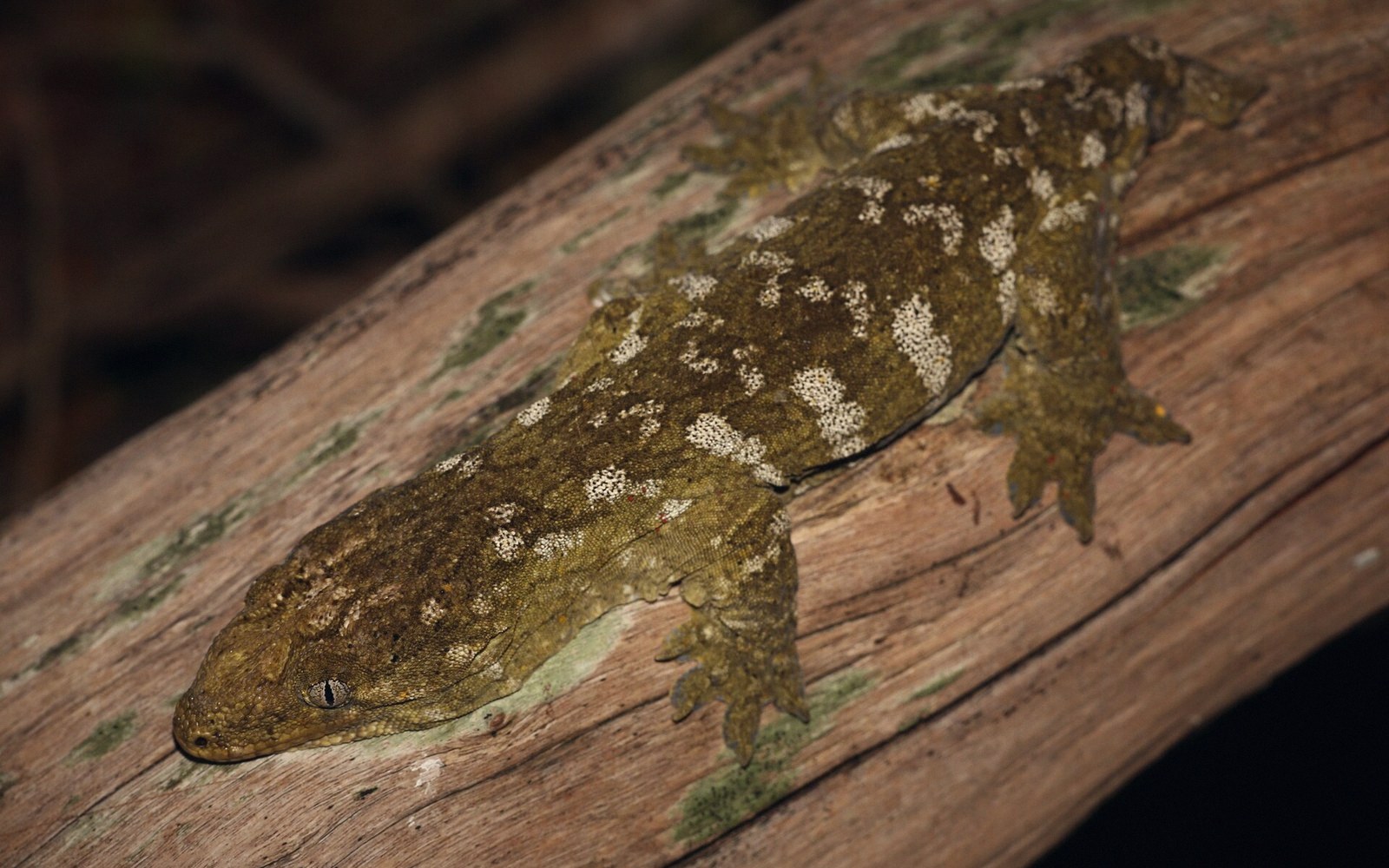
The standout is Rhacodactylus leachianus — the leachie, or New Caledonian giant gecko — which regularly reaches 35 centimetres and is among the largest geckos alive. It is a forest animal, nocturnal, and built for an arboreal life: broad toe pads, a prehensile tail, and a grip strong enough to hold position on bark through considerable wind.
Juveniles are notably aggressive. The species occurs across the southern part of Grande Terre and on Île des Pins, where an island population produces individuals that differ in size and patterning from mainland animals — a pattern replicated across the archipelago wherever water barriers have allowed populations to diverge.
The genus Rhacodactylus itself is endemic to New Caledonia and includes several other large, soft-skinned species now widely kept in captivity worldwide, among them R. ciliatus, the crested gecko, which was believed extinct until its rediscovery in 1994 in the south of Grande Terre. R. auriculatus, the gargoyle gecko, occupies drier scrub and forest edge, and shows strong individual colour variation even within a single population.
The figures
Lifted out of the textSmaller but no less diverse, the diplodactylid geckos radiated into almost every microhabitat the island offers — rock faces, leaf litter, canopy — with genera such as Bavayia and Eurydactylodes holding dozens of endemic species between them. This family is itself a Gondwanan lineage, its New Caledonian branch isolated long enough to produce forms found nowhere else in the Pacific.
The skinks tell a different story. Several genera within the family Scincidae colonised the island by overwater dispersal rather than Gondwanan inheritance, and have since speciated steadily. The genus Caledoniscincus accounts for a substantial share of the island's skink diversity, with species distributed across different vegetation zones, from the coastal strand to cloud-forest.
Field notes
Facts, threats and strongholdsKey species
- Caledoniscincus spp. — endemic skink genus; multiple species across vegetation zones
- Bavayia, Eurydactylodes — diplodactylid gecko genera; Gondwanan lineage; dozens of endemic species
What shaped this fauna
- No native land mammals (except bats) — lizards radiated into vacant niches
- Gondwanan inheritance (diplodactylids) vs. overwater dispersal (most skinks)
- Island isolation repeatedly produced distinct populations and species across the Loyalty Islands
- Introduced predators (cats, rats) now the main pressure on ground-dwelling species
Ground-dwelling skinks are particularly sensitive to introduced predators — cats and rats press hardest on low-canopy and ground species — and populations on the Loyalty Islands, including Lifou and Maré, sometimes diverge enough from Grande Terre relatives to constitute separate species.
Taken together, this lizard fauna is a working record of what happens when small, cold-blooded vertebrates are left to diversify across a geologically complex island for millions of years: the niches fill, the forms multiply, and the largest gecko you are ever likely to see ends up living in a tree on the edge of a nickel-mining massif.