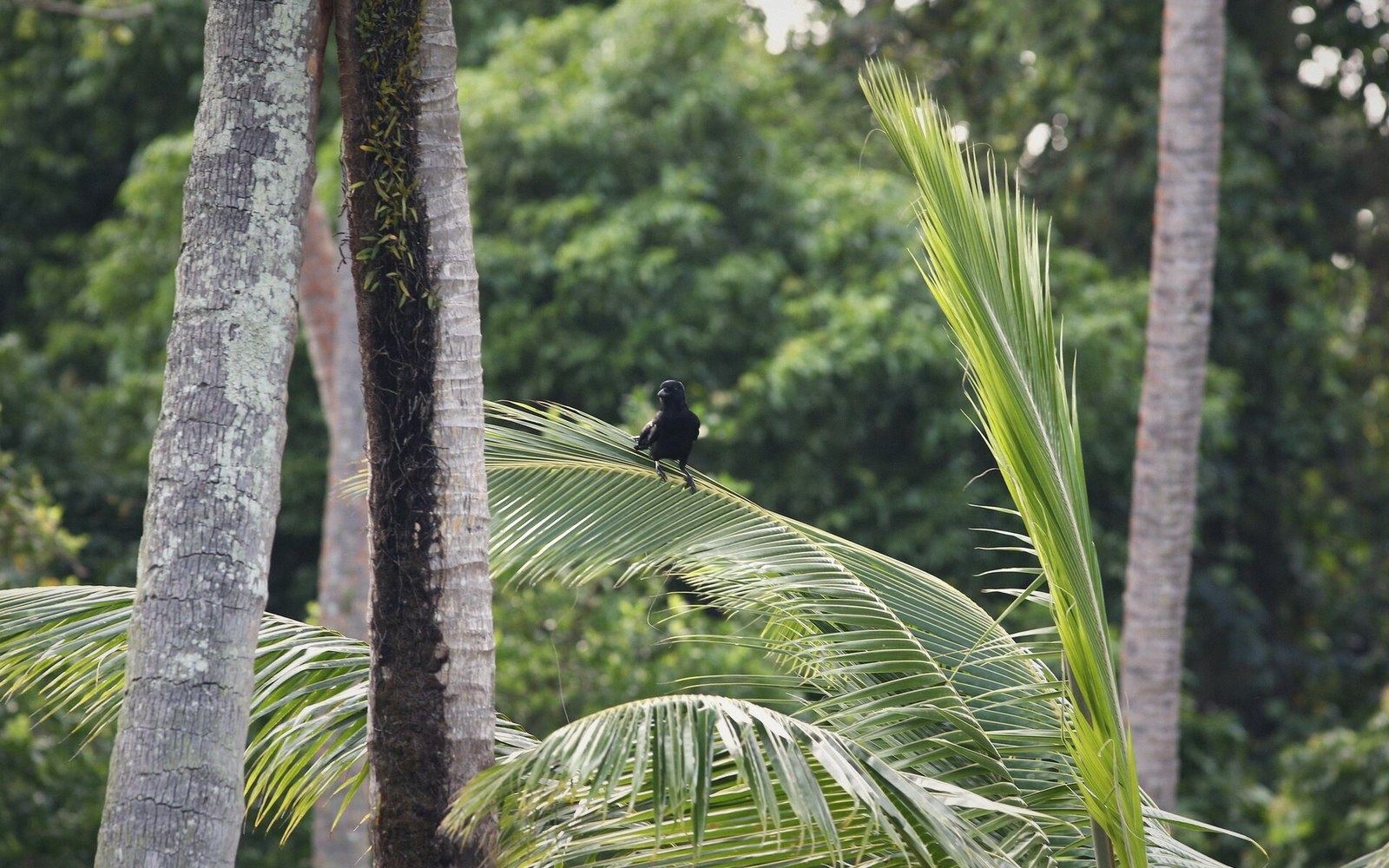
A crow that cuts and shapes
Corvus moneduloides — the New Caledonian crow — is plain to look at: black, compact, roughly the size of a European carrion crow, with a slightly upturned bill that is, as it turns out, no accident of anatomy.
It lives across the main island of Grande Terre and on the Loyalty Islands, foraging in forest, forest edge and degraded scrub. Nothing about its plumage marks it as extraordinary. What it does with a strip of pandanus leaf is another matter.
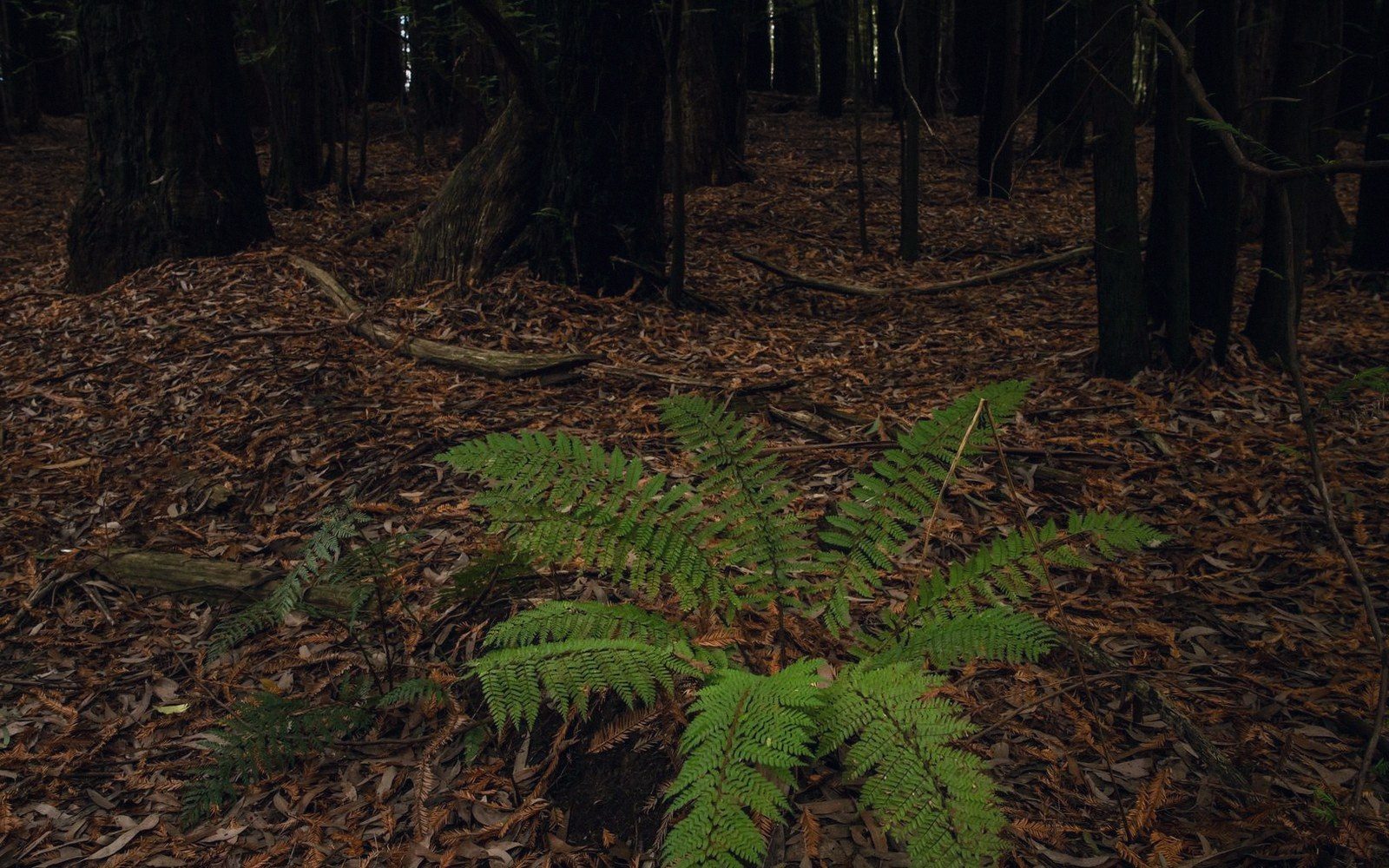
The crow tears a tapered strip from the serrated edge of a pandanus frond, leaving a sharp hook at the base where the strip was attached to the midrib. That hook goes into a crack in bark or a beetle larva's tunnel.
The crow holds the tool, feels resistance, and pulls the larva out. The whole sequence — selecting a leaf, cutting to a precise taper, retaining and reusing the tool while moving between sites — is manufacture, not improvisation. The tool is shaped before the prey is found.
Outside the primates, very few animals make tools to this standard. Sea otters use stones as anvils; some wasps pack soil with a pebble; Egyptian vultures throw rocks at ostrich eggs. These are tool use. The New Caledonian crow does something structurally different: it modifies raw material to a functional specification. The hook is not found; it is made.
Researchers at the University of Auckland and the University of Oxford, working with wild and captive birds over several decades, have documented not only the behaviour but the neural correlates behind it — the birds hold a mental template of the finished tool before they begin cutting, a capacity once considered a marker of higher cognition in humans.
What the island gave the crow
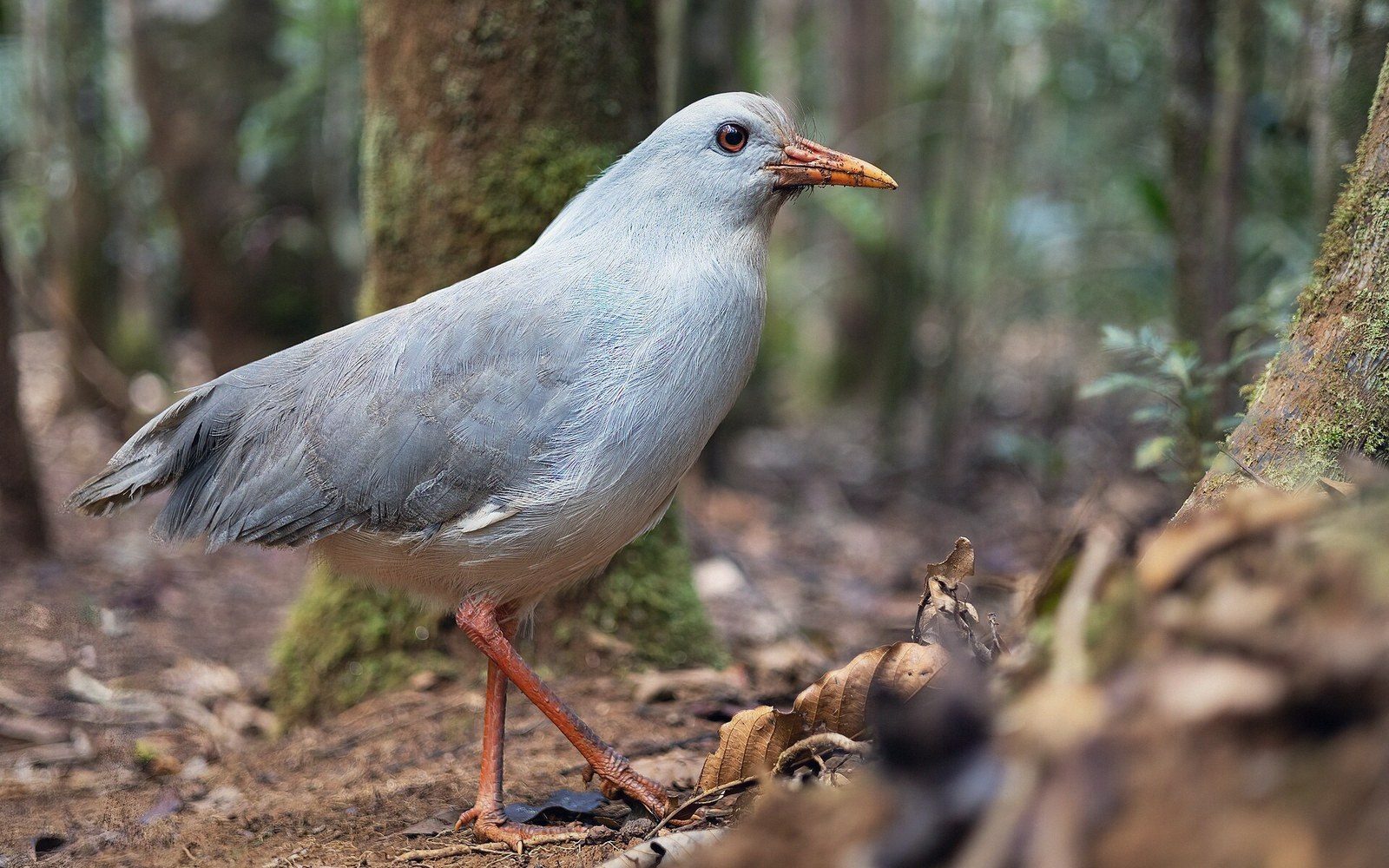
Why here? The question is worth taking seriously. Grande Terre is old, isolated and ecologically peculiar. Seventy-odd million years of separation from any landmass produced a fauna with notable gaps — no native terrestrial mammals other than bats, no woodpeckers, no treecreepers. The niche of extracting invertebrates from wood exists; the usual guild of hole-probing specialists largely does not.
The crow appears to have filled it, developing tools in place of the long bill and specialised skull musculature a woodpecker uses. This is the ecological argument, though it remains a hypothesis: the right conditions, the right starting intelligence, an empty niche, and enough generations.
Field notes
Facts, threats and strongholdsCognitive benchmarks
- Tool manufacture — shaping or modifying raw material before use; the crow's defining behaviour
- Mental template — holding a representation of a finished tool before beginning to make it; documented in Corvus moneduloides by multi-institutional research
Key facts
- Species: Corvus moneduloides, the New Caledonian crow
- Range: Grande Terre and the Loyalty Islands; found nowhere else
- Tool material: principally pandanus frond strips, cut to a hooked taper
- Research institutions: University of Auckland, University of Oxford (among primary investigators)
- Closest ecological analogy: woodpeckers fill the same invertebrate-extraction niche on most forested islands; New Caledonia has none
The crow's tools also vary by island. Birds on Grande Terre typically make hooked pandanus tools; those studied elsewhere use different materials and simpler forms. These differences persist across generations in the same population — they are transmitted, not reinvented. Whether that constitutes culture in a strict biological sense is debated, but the data from long-term field studies at sites across Grande Terre suggest that tool traditions are socially learned, with juveniles acquiring techniques by observing adults.
Pandanus itself is worth a note. The trees grow widely across the Pacific and into Southeast Asia, but the serrated-leaf species that the crow exploits with such precision are part of its immediate environment on Grande Terre and the Loyalty Islands.
The match between tool material and tool design is tight enough that researchers have argued the crow's slightly curved bill — straighter than most corvids', with a subtly hooked tip — may have co-evolved with its tool use, though demonstrating co-evolution cleanly requires a fossil record the island has not yet yielded.
The crow is not endangered, and it is not rare in the right habitat. It is also, by corvid standards, cautious — difficult to approach in the wild, quick to abandon a feeding site when disturbed.
The best observations have come from provisioned birds in field enclosures and from careful, patient work with wild-caught individuals in university facilities in Europe and New Zealand. What those observations have produced is a body of research that has reshaped how animal cognition is understood. The bird did not read those papers. It is still out there, cutting hooks from pandanus.