A lineage without a parallel
Rhynochetos jubatus is, in biological terms, alone. The kagu belongs to its own family — Rhynochetidae — and its own order, and molecular work has placed it closest to the sunbittern of Central and South America, with whom it shares little more than a ghost of shared ancestry.
That connection puts the divergence deep enough in geological time that the two lineages have evolved almost no common traits beyond a few skeletal details. For practical purposes, the kagu has no living relative worth naming.
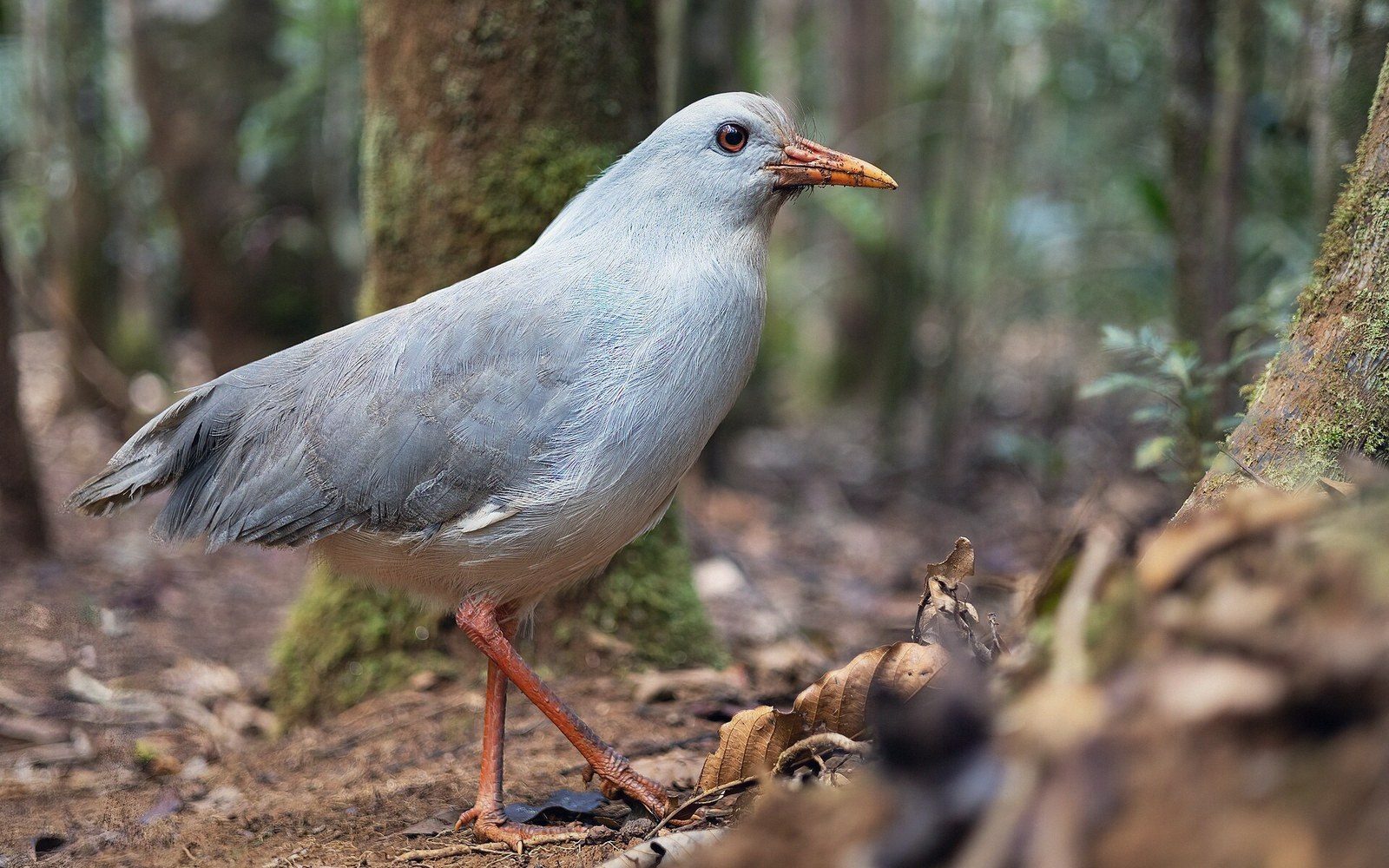
The bird is native to Grande Terre and only to Grande Terre. It is roughly the size of a small heron, grey-white with a loose, drooping crest that it fans into a dramatic disc when alarmed or courting. The wings are barred orange and black — bars that become visible only when the wings are spread, which happens rarely, because the kagu cannot fly.
Its wings are not vestigial; it uses them for balance on steep ground and for gliding short distances downhill, but powered flight is gone. The kagu's pectoral muscle mass is among the lowest recorded in any bird, and its sternum lacks the deep keel that anchors flight muscles in flying species.
What it does instead is walk. The kagu is a forest-floor predator, working through leaf litter for earthworms, snails, lizards and large insects. Its bill is long and slightly laterally compressed, and its nostrils are covered by unique flap-like structures — found in no other bird — that may prevent soil from entering when it probes.
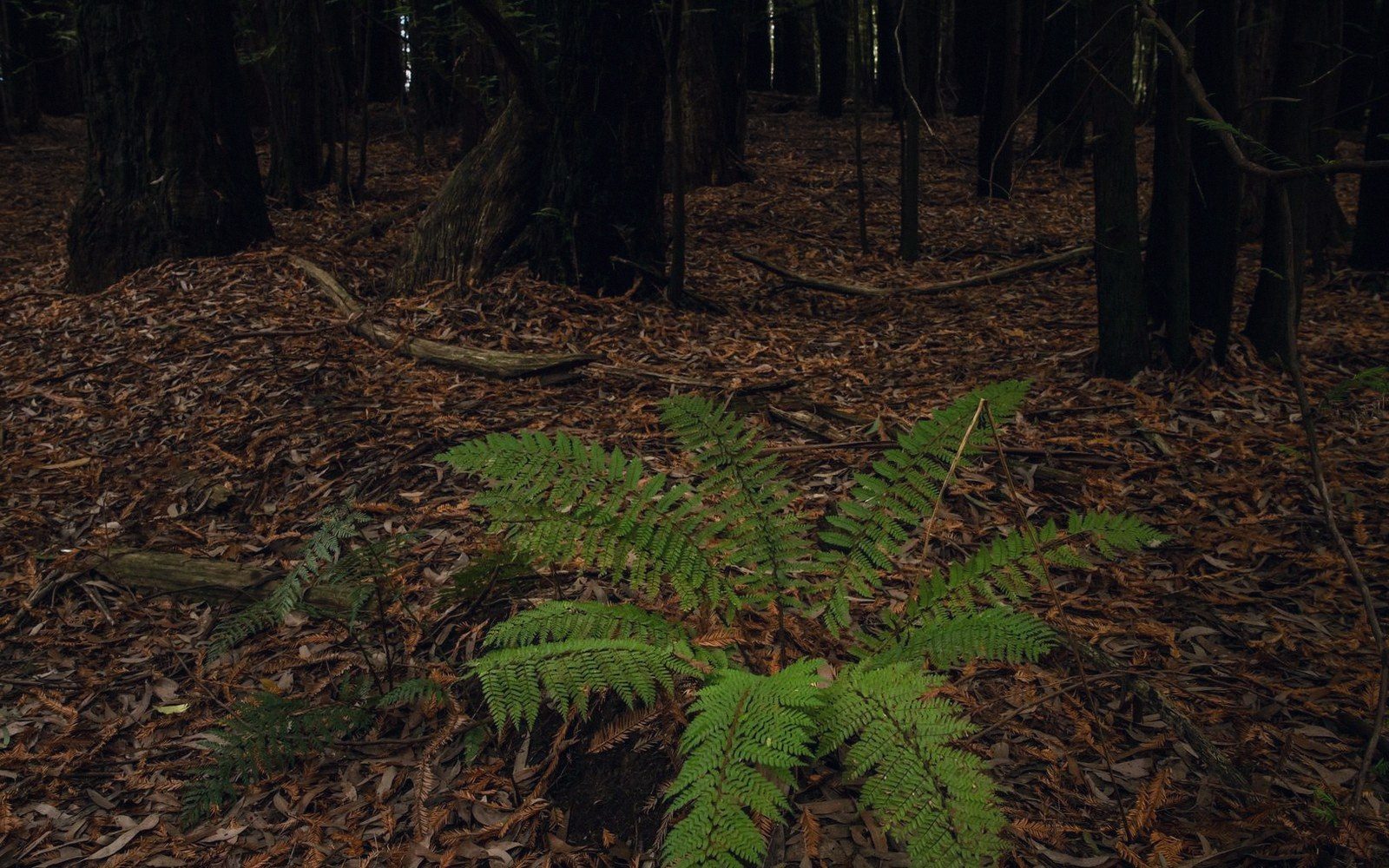
Its eyes are large and deep red-orange, suited to the dim understorey. It is a bird shaped entirely by a closed, stable forest system, with no evolutionary pressure to escape predators by flight because, until humans arrived with dogs, cats and rats, there were no ground predators to flee.
On the ground and at risk
The kagu's call is one of the most distinctive sounds in the Pacific: a series of loud, nasal, almost mechanical barks, often performed as a dawn duet between paired birds. Both parents incubate a single egg and share the raising of the chick; this slow reproductive rate means that populations recover from decline only with difficulty.
Rivière Bleue Provincial Park, in the south of Grande Terre, holds the best-studied and most stable kagu population. The park operates a long-running predator-control programme, and the density of birds there is significantly higher than in unmanaged forest.
Field notes
Facts, threats and strongholdsKey biological facts
- Closest living relative: the sunbittern (Eurypyga helias), Central and South America
- IUCN status: Endangered
- Sternum lacks a flight-muscle keel; pectoral mass among the lowest in any bird
- Unique nasal flap structures found in no other bird species
- Single egg per clutch; both parents incubate
Threats and strongholds
- Primary threat: dogs (feral and hunting), followed by rats and habitat loss
- Rivière Bleue Provincial Park — main protected population, active predator control
- Range contracted significantly across Grande Terre over the past 150 years
Outside Rivière Bleue and a few other protected areas, the kagu's range has contracted severely over the past century and a half. Dogs are the primary modern threat — both feral animals and hunting dogs that range into forest — with rats preying heavily on eggs and chicks. Habitat clearance has reduced the closed-canopy forest the species requires.
The kagu is listed as Endangered on the IUCN Red List, though the Rivière Bleue population in particular has stabilised under active management. It is the emblem of New Caledonia in a way that is not purely symbolic: a flightless, forest-bound bird descended from a lineage that survived the island's isolation from Gondwana, shaped by conditions that no longer exist, and surviving now only where its environment is deliberately defended.
The kagu carries something the island's geology and botany also carry — a specificity so deep it amounts to irreplaceability. There is no backup population somewhere else. There is no related species that would fill the same role if this one disappeared. It is, in that respect, a fair emblem of New Caledonia itself.