Structure and meaning
A grande case — the term is French, literally "big house," but the thing itself is entirely Kanak — rises from cleared ground at the head of a clan's allée, the ceremonial path lined with araucaria pines that leads the eye inward from the entrance to the house's pointed spire.
The form is immediately recognisable: a steep conical roof thatched over a circular timber frame, its ridgeline drawn up to a single vertical spear, the flèche faîtière, that projects into the sky above the apex. Everything about the silhouette is intentional. The height of the spear, the taper of the cone, the orientation of the door — none of it is decorative in the sense of being optional.
The structural logic begins underground. A single central post, often of ironwood (Casuarina collina), is sunk deep into the earth and rises through the interior to carry the entire roof load. Around it, a circle of secondary posts defines the wall line; between them, woven panels of pandanus or split bamboo close the space against wind and rain.
The framing requires no metal fastener. The joints are bound with plant cord and rely on the geometry of compression rather than tension — a technique developed over many generations in a landscape that offered abundant timber and fibre and demanded resistance to cyclone.
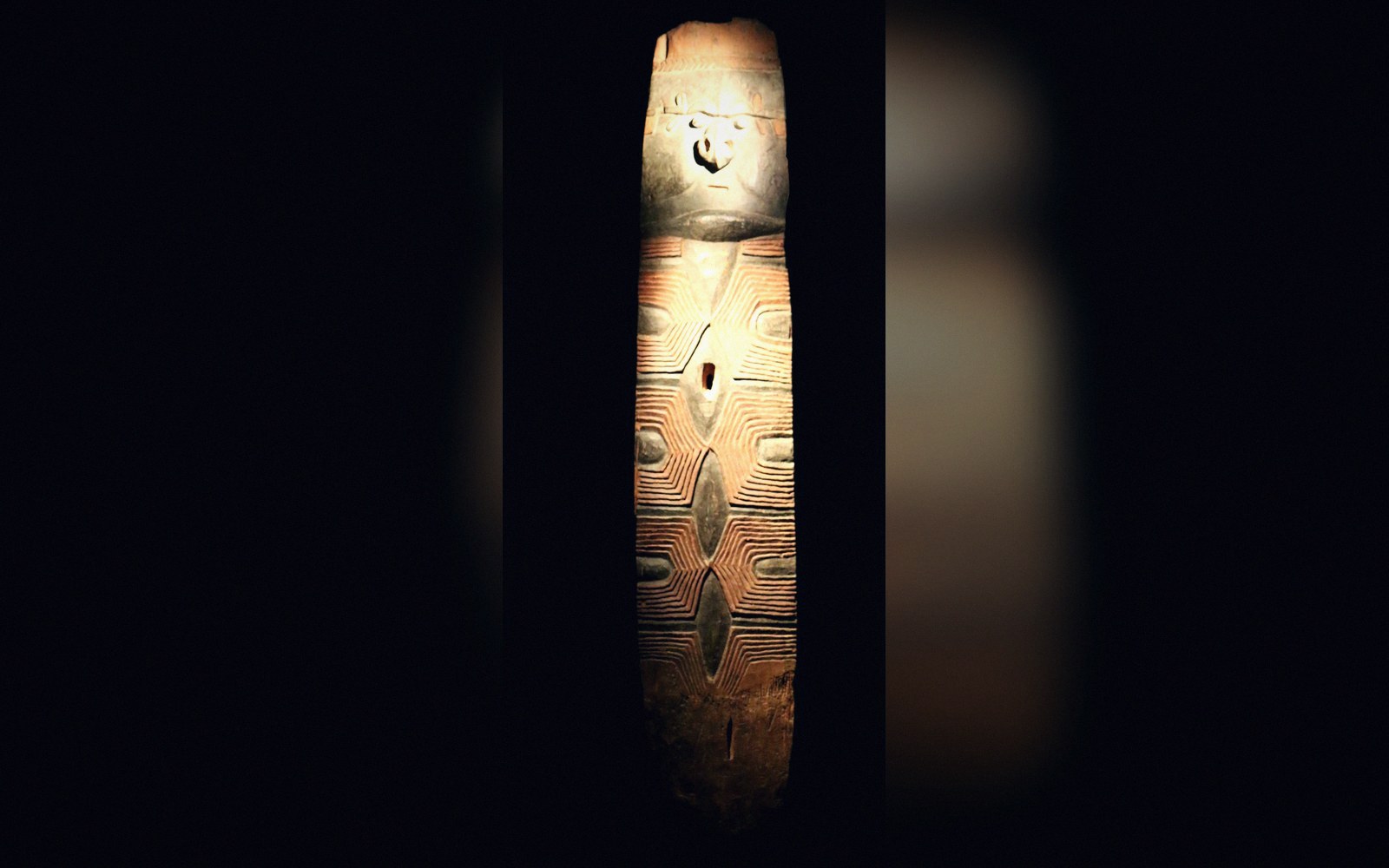
The door jambs demand close attention. They are carved in low relief, their registers of human figures and geometric motifs encoding clan genealogy and status. The figures are not symbolic in a vague sense; they carry specific information readable by those who know the lineage.
The carving work has traditionally been the responsibility of particular specialists within the clan, and the imagery is not interchangeable between houses. Above the door, the lintel reinforces the threshold as a conceptual and social boundary: to enter is to acknowledge the authority of the chief whose house this is.

Presence in the clan ground
The grande case is the residence of the chief, but calling it a house understates what it does. It is the spatial anchor of the clan's ground (nakamal in some regional vocabularies, though terminology varies across the island's languages), the point from which the allée extends outward and from which authority radiates.
Everyday dwellings — smaller, rectangular, functionally domestic — are positioned in relation to it. The grande case gives the settlement its orientation in both a physical and a social sense.
Field notes
Facts, threats and strongholdsKey terms
- allée — the ceremonial path, typically lined with araucaria pines, leading to the grande case
- nakamal — a term used in some regional vocabularies for the clan's ceremonial ground; terminology varies by language
- grande case — literally "big house" in French; the Kanak conical chief's house built around a central post
What the building is made of
- Central post: ironwood (Casuarina collina), sunk into the earth
- Frame: secondary timber posts in a circle; no metal fasteners
- Walls: woven pandanus or split bamboo panels
- Roof: thatched, steeply conical
- Door jambs: carved in low relief with clan genealogy and figural motifs
- Binding: plant cord and compression joinery
Different regions of Grande Terre and the Loyalty Islands — Lifou, Maré, Ouvéa — show variation in proportion, thatch material and carved detail, reflecting the linguistic and cultural differentiation of Kanak communities across the archipelago. The around-thirty distinct Kanak languages spoken across New Caledonia correspond to communities with their own architectural emphases, though the central-post-and-spear grammar persists broadly.
What counts as the correct material for the flèche faîtière, the right depth for a figure carved on the jamb, the appropriate height of the allée pines — these are locally held knowledge, not archipelago-wide conventions.
The form entered wider consciousness partly through architecture. When Renzo Piano developed the Tjibaou Cultural Centre in Nouméa in the 1990s, the ten timber shells he raised along the Tina Peninsula took the grande case's vertical thrust and brise-soleil logic as a structural reference point, without reproducing the building or claiming its cultural content. The result acknowledged the form while remaining entirely its own thing.
Grandes cases continue to be built on customary land. They are not museum objects or reconstructions for any audience outside the clan. Where one stands, it stands because a chief lives in it and a lineage maintains it, and the ground it occupies is held under customary tenure — a living arrangement, not a historical one. The flèche faîtière above it is not picturesque skyline; it marks a place where authority has a name.